Case studiesMarketing & distribution
Building it is half the job. Getting it seen is the other half.
How Proxy IT puts PrintedPrice.com in front of its audience: short-form video built on a catchy hook and a real answer, a brand voice people recognize, and pages that search engines and AI assistants can find and trust.
Printed Price (printedprice.com) is a trade name of Proxy IT LLC.
- 4
- community channels: X, Instagram, YouTube Shorts and Discord
- 90
- pages in the search sitemap
- 457
- vetted shops behind every answer
- 0
- paid placements: nobody can pay to appear
Distribution has to be designed, just like the code.
Attention now starts in short-form feeds: Reels, TikTok and Shorts. That's where collectors first meet a new tool, a new deal, or a new way of thinking about a problem.
So distribution is built into Printed Price from the start. Every short video opens with a hook the audience already feels, delivers a real answer, and points to a page that answers it in full. Search engines and AI assistants can then find, read and trust that page long after the video has scrolled away.
A catchy hook, then a real answer
Clickbait wins a view and loses the follower. Short-form works when the hook earns attention and the answer earns trust.
Hook
The first two seconds. A question the audience already has, in their own words.
Answer
A real, specific answer, not a tease. Viewers should leave knowing something useful.
Proof
The receipts on screen: the live page, the price, the source.
Path
One next step: the page that answers it in full, or a free alert for the next drop.
Example hooks, written from Printed Price's own data
Each one pairs a scroll-stopping line with an answer the site already backs up.
The box says $49.99. One big store charged $120.
Answer: the store report card grades every big retailer against the price on the box, and cites its sources.
Points to /report-card
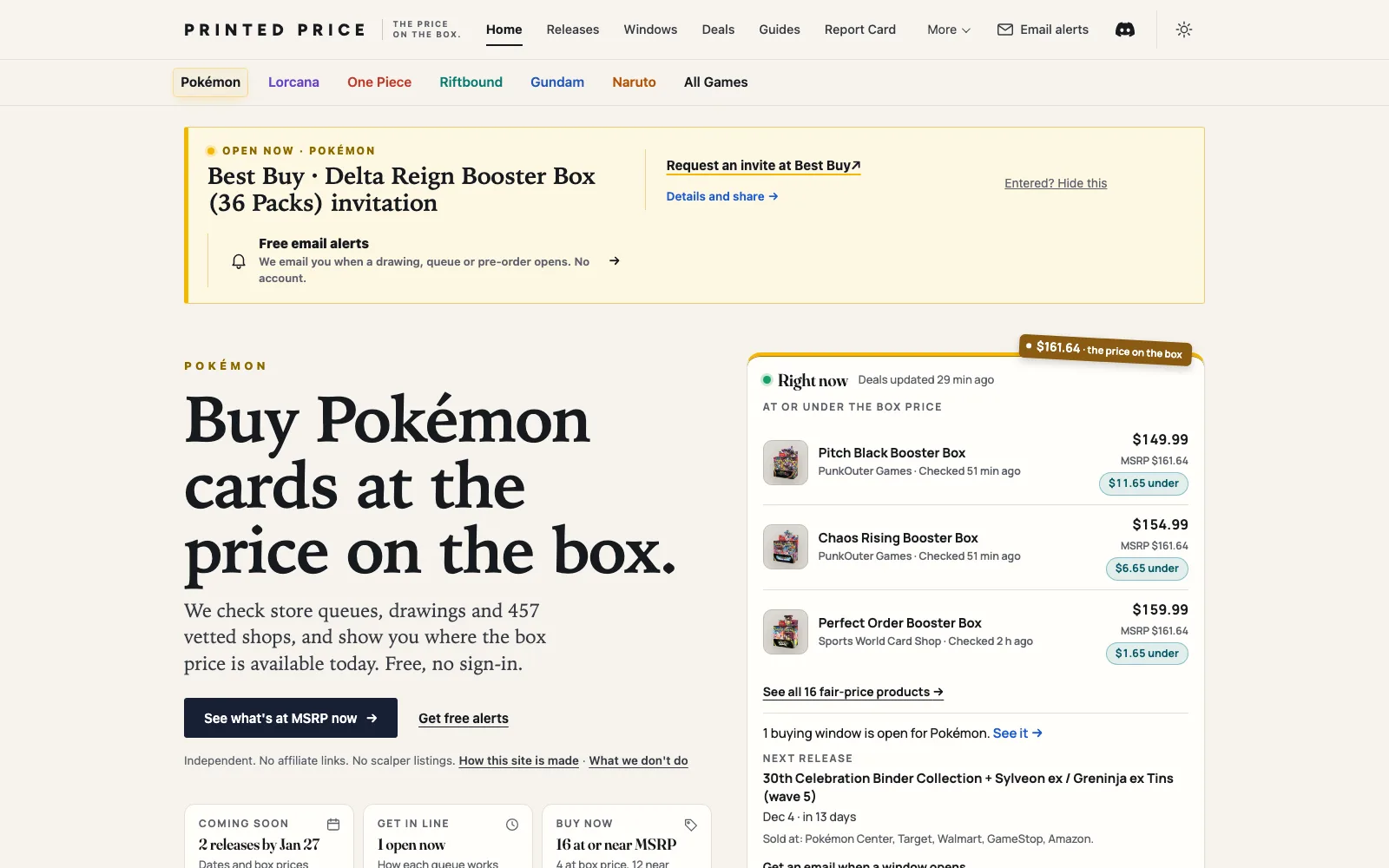
457 shops checked. Here's who's selling at the price on the box.
Answer: a live list of fair-price inventory from vetted stores, with when each offer was last checked.
Points to /deals
A big retailer is taking invites right now. Here's how to get one.
Answer: the step-by-step for that buying window, plus a free alert so you hear about the next one.
Points to /windows and email alerts
Recognizable in one second, trusted in thirty
A name that is the promise
"Printed Price" says what the brand stands for before anyone reads a word more: the price on the box.
A look you can spot in a feed
Editorial headlines, warm paper tones and a signature color for each game, carried from the site into every video and post.
A plain, direct voice
Short, honest lines like "Free, no sign-in." and "No scalpers. No marketplace resellers." No hype, no countdown-timer pressure.
Credibility you can check
Figures link to their sources, rumors are labelled as rumors, a dated corrections log owns every mistake, and nobody can pay to appear.
From a scroll to a returning audience
Each video does one job: move someone one step closer to an audience the brand owns.
Step 1: Short video
A hook and a real answer meet the audience where they already scroll.
Step 2: Answer page
The full, sourced answer lives on a fast page built to be found again.
Step 3: Free alert
Email alerts with no account turn a one-time viewer into a subscriber.
Step 4: Next drop
Each new release or buying window becomes the next hook, and the loop repeats.
Video wins attention for a day. Search and AI discoverability keep the answer page working for months.
Built to be found by people, search engines and AI assistants
Some people now ask an AI assistant before they search. A page has to be readable, crawlable and trustworthy to both.
Search engine optimization
The foundations that let search engines understand every page.
- Server-rendered at the edge: content arrives in the HTML, fast, without waiting on JavaScript.
- Clean metadata: descriptive titles and descriptions, plus canonical URLs.
- An XML sitemap listing 90 pages, from guides to individual set releases.
- Share cards for social and chat apps: Open Graph and X cards with a custom 1200×630 image and alt text.
- Structured data: Organization and WebSite markup site-wide, with the glossary marked up as a set of defined terms.
AI & LLM crawling
A deliberate policy on which AI crawlers get in, and content they can quote accurately.
- Selective crawler policy: open to search and answer engines, closed to bulk-scraping crawlers that would copy the data wholesale.
- Answer-first pages: built around direct questions like "what's fair now?", so the answer is easy to find and cite.
- Plain HTML content that crawlers can read even when they don't run JavaScript.
- Trust signals: sourced figures, labelled rumors and a public corrections log.
# printedprice.com/robots.txt (excerpt)
User-agent: *
Allow: /
Disallow: /api/

User-agent: CCBot
Disallow: /

User-agent: Bytespider
Disallow: /
Distribution, delivered by Proxy IT
We don't stop at launch. We build the audience around what we ship, for our own products and for yours.
Brand identity & voice
Name, promise, visual system and a voice guide, so every post sounds and looks like you.
Reels, TikTok & Shorts
Hook writing, scripting, editing, captions and a posting rhythm built around real answers.
Answer pages that convert
Fast pages that finish the story the video started, with one clear next step.
Search foundations
Server rendering, metadata, sitemaps, share cards, structured data and page speed.
AI discoverability
Crawler policy, answer-first content, structured data and llms.txt, so AI assistants can find and cite you.
What's actually working
Tracked links and analytics that show which hooks bring visitors, subscribers and customers.
Built something great that nobody's seen yet?
Let's give it a hook, a voice and pages people and AI assistants can find. No pitch, just a conversation.
-
Related case study
How we built PrintedPrice.com
The edge architecture, data pipeline and scoring model behind the platform.
Read the build case study -
Next case study
PrintedPrice.com: watching it run
Data freshness, dashboards, alerts
Read the monitoring case study